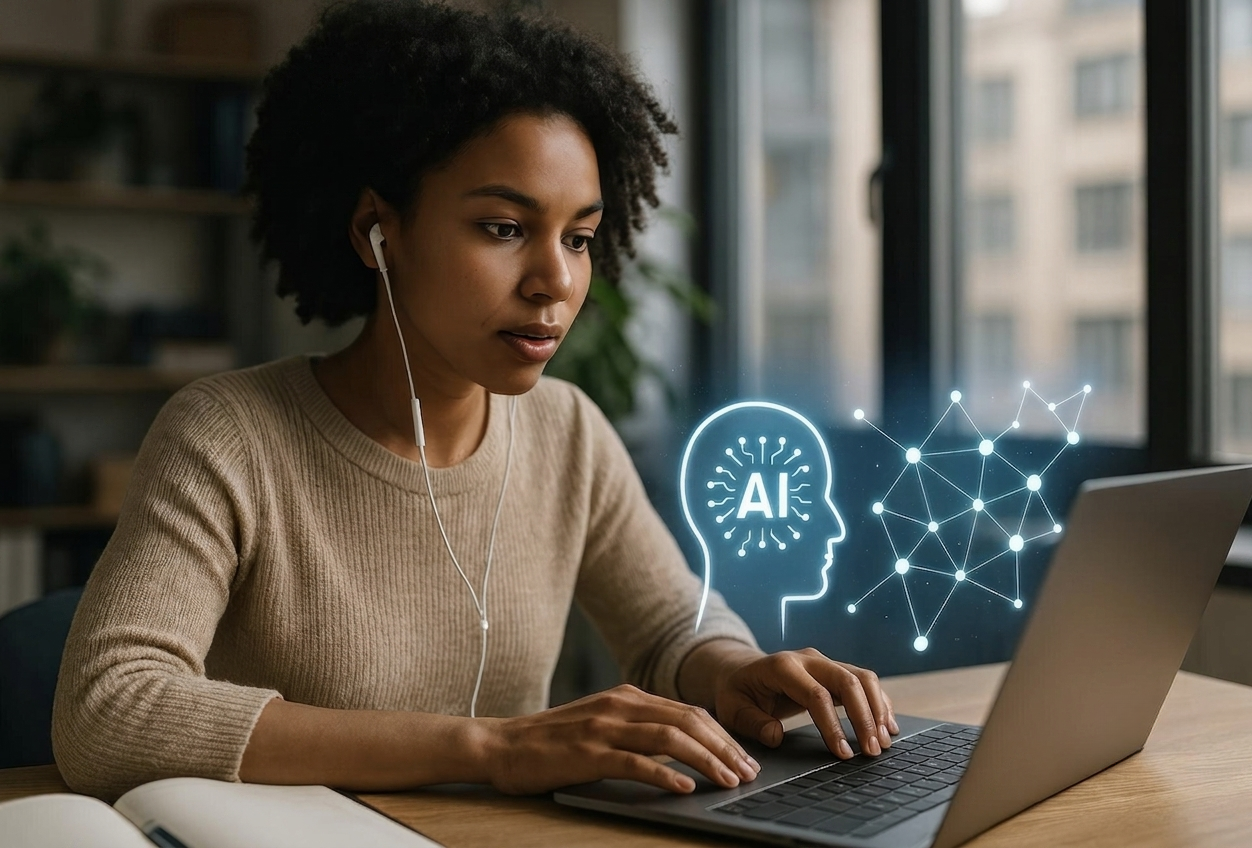
Human-in-the-loop transcription combines AI efficiency with human expertise to produce reliable transcripts.
Key Takeaways
AI transcription has dramatically improved speed, but human review remains essential for professional accuracy.
Transcript editors correct errors involving speaker identification, context, technical terminology, and formatting.
Industries such as legal, healthcare, research, media, and corporate communications continue to depend on professionally edited transcripts.
The future of transcription isn't AI replacing humans — it's AI and humans working together.
The Rise of the AI Transcript Editor: Why Human Review Still Matters in 2026
Artificial intelligence has transformed transcription faster than almost anyone predicted.
Only a few years ago, headlines suggested that Automated Speech Recognition (ASR) technologies would replace professional transcriptionists altogether. Tools like OpenAI Whisper, Google Speech-to-Text, Microsoft Azure Speech, and Deepgram demonstrated remarkable capabilities by converting hours of audio into text within minutes.
For many transcription professionals, it appeared that the industry was heading toward complete automation.
Instead, something unexpected happened.
As organizations adopted AI transcription software at scale, they discovered that speed alone doesn't guarantee accuracy. While AI excels at generating first drafts, it still struggles with context, speaker identification, technical vocabulary, poor audio quality, and real-world conversations that rarely resemble laboratory recordings.
Rather than eliminating transcription professionals, artificial intelligence created an entirely new role:
Only a few years ago, headlines suggested that Automated Speech Recognition (ASR) technologies would replace professional transcriptionists altogether. Tools like OpenAI Whisper, Google Speech-to-Text, Microsoft Azure Speech, and Deepgram demonstrated remarkable capabilities by converting hours of audio into text within minutes.
For many transcription professionals, it appeared that the industry was heading toward complete automation.
Instead, something unexpected happened.
As organizations adopted AI transcription software at scale, they discovered that speed alone doesn't guarantee accuracy. While AI excels at generating first drafts, it still struggles with context, speaker identification, technical vocabulary, poor audio quality, and real-world conversations that rarely resemble laboratory recordings.
Rather than eliminating transcription professionals, artificial intelligence created an entirely new role:
The AI Transcript Editor.
Today, businesses, researchers, legal professionals, journalists, and content creators increasingly rely on human-in-the-loop transcription—a workflow where AI performs the initial transcription and experienced editors ensure the final transcript accurately reflects what was actually said.
This hybrid approach has quickly become the industry standard for organizations where quality, compliance, and accuracy matter.
This hybrid approach has quickly become the industry standard for organizations where quality, compliance, and accuracy matter.
Why AI Transcription Changed the Industry
The introduction of modern speech-to-text models fundamentally reshaped the transcription workflow.
Tasks that once required several hours can now be completed in a matter of minutes.
Instead of typing every spoken word manually, transcription professionals now spend their time reviewing, correcting, and improving AI-generated drafts.
This shift has significantly increased productivity while allowing editors to focus on what humans do best:
Tasks that once required several hours can now be completed in a matter of minutes.
Instead of typing every spoken word manually, transcription professionals now spend their time reviewing, correcting, and improving AI-generated drafts.
This shift has significantly increased productivity while allowing editors to focus on what humans do best:
Understanding context
Interpreting meaning
Resolving ambiguity
Identifying speakers
Correcting technical terminology
Producing polished, publication-ready transcripts
In other words, AI didn't remove the need for human expertise—it elevated it.
AI Transcription by the Numbers
Recent advances in speech recognition have made AI transcription more capable than ever before.
Under ideal conditions, modern ASR systems can achieve impressively low Word Error Rates (WER) when processing clear speech from a single speaker using high-quality recording equipment. Research from OpenAI's Whisper model and leading cloud speech platforms consistently demonstrates substantial improvements over earlier generations of speech recognition.
However, those same providers also acknowledge that transcription accuracy decreases when recordings contain:
Under ideal conditions, modern ASR systems can achieve impressively low Word Error Rates (WER) when processing clear speech from a single speaker using high-quality recording equipment. Research from OpenAI's Whisper model and leading cloud speech platforms consistently demonstrates substantial improvements over earlier generations of speech recognition.
However, those same providers also acknowledge that transcription accuracy decreases when recordings contain:
Background noise
Multiple speakers
Heavy accents
Domain-specific terminology
Crosstalk
Poor microphone quality
Echo or reverberation
Low-volume speech
This is precisely why platforms such as OpenAI Whisper, Microsoft Azure Speech, Google Cloud Speech-to-Text, and Deepgram all provide editing tools or recommend human review for applications where transcription accuracy is critical.
For organizations handling contracts, interviews, legal proceedings, medical documentation, research data, or public-facing content, a transcript is more than just text—it becomes part of the official record.
Accuracy matters.
For organizations handling contracts, interviews, legal proceedings, medical documentation, research data, or public-facing content, a transcript is more than just text—it becomes part of the official record.
Accuracy matters.
Why AI Transcription Still Makes Mistakes
Artificial intelligence recognizes speech by identifying statistical language patterns learned from enormous datasets.
It does not understand conversations the way people do.
While AI has become remarkably good at predicting words, it still lacks human judgment.
Consider a real-world business meeting.
Several people begin speaking simultaneously.
One participant joins remotely using a poor internet connection.
Another has a strong regional accent.
Someone references a product using an acronym that sounds identical to a common English word.
A participant quietly agrees from across the room.
For a human listener, these situations are usually manageable.
For AI, they represent some of the most challenging transcription scenarios.
Common transcription issues include:
It does not understand conversations the way people do.
While AI has become remarkably good at predicting words, it still lacks human judgment.
Consider a real-world business meeting.
Several people begin speaking simultaneously.
One participant joins remotely using a poor internet connection.
Another has a strong regional accent.
Someone references a product using an acronym that sounds identical to a common English word.
A participant quietly agrees from across the room.
For a human listener, these situations are usually manageable.
For AI, they represent some of the most challenging transcription scenarios.
Common transcription issues include:
1.
Why AI Transcription Still Makes Mistakes
AI may merge two speakers into one or assign dialogue to the wrong participant.
For interviews, podcasts, legal proceedings, or board meetings, this can completely alter the meaning of a conversation.
For interviews, podcasts, legal proceedings, or board meetings, this can completely alter the meaning of a conversation.
2.
Technical Terminology
AI may merge two speakers into one or assign dialogue to the wrong participant.
For interviews, podcasts, legal proceedings, or board meetings, this can completely alter the meaning of a conversation.
For interviews, podcasts, legal proceedings, or board meetings, this can completely alter the meaning of a conversation.
3.
Overlapping Conversations
People naturally interrupt each other.
They laugh.
Pause.
Finish each other's sentences.
They speak over one another.
Humans usually interpret these conversations effortlessly.
AI often cannot.
They laugh.
Pause.
Finish each other's sentences.
They speak over one another.
Humans usually interpret these conversations effortlessly.
AI often cannot.
4.
Background Noise
Construction sites.
Coffee shops.
Hospitals.
Conference halls.
Manufacturing facilities.
These environments introduce competing sounds that interfere with speech recognition.
Even advanced AI models struggle when the speech signal competes with environmental noise.
Coffee shops.
Hospitals.
Conference halls.
Manufacturing facilities.
These environments introduce competing sounds that interfere with speech recognition.
Even advanced AI models struggle when the speech signal competes with environmental noise.
5.
Context
Perhaps AI's greatest limitation is context.
Imagine someone says:
"We'll archive the client file after legal review."
An AI working with distorted audio might transcribe:
"We'll arrive the client file after eagle review."
The transcript may appear grammatically acceptable while conveying entirely different information.
In high-stakes industries, these aren't harmless mistakes.
They're business risks.
In high-stakes industries, these aren't harmless mistakes.
They're business risks.
At CadreScripts, We've Seen This Firsthand
Since adopting AI-assisted transcription workflows, we've reviewed thousands of machine-generated transcripts across business meetings, podcast interviews, research projects, webinars, customer interviews, and legal recordings.
Most AI errors aren't dramatic.
They're subtle.
A missing word.
A wrongly identified speaker.
An incorrect product name.
A medical abbreviation expanded incorrectly.
A sentence that technically makes sense—but completely changes the intended meaning.
These are exactly the kinds of mistakes that software struggles to detect because they require human reasoning rather than statistical prediction.
That's why professional transcript editing remains an essential quality assurance step.
Most AI errors aren't dramatic.
They're subtle.
A missing word.
A wrongly identified speaker.
An incorrect product name.
A medical abbreviation expanded incorrectly.
A sentence that technically makes sense—but completely changes the intended meaning.
These are exactly the kinds of mistakes that software struggles to detect because they require human reasoning rather than statistical prediction.
That's why professional transcript editing remains an essential quality assurance step.
What Does an AI Transcript Editor Actually Do?
Contrary to popular belief, transcript editors don't simply proofread spelling mistakes.
Their work is far more analytical.
An experienced transcript editor listens to the original recording while reviewing the AI-generated draft.
Their responsibilities include:
Their work is far more analytical.
An experienced transcript editor listens to the original recording while reviewing the AI-generated draft.
Their responsibilities include:
Verifying every speaker
Correcting transcription errors
Restoring punctuation
Improving readability
Confirming technical terminology
Checking timestamps
Removing AI hallucinations
Identifying unintelligible speech
Ensuring formatting consistency
Preserving the speaker's intended meaning
The goal isn't simply producing readable text.
The goal is producing a transcript that someone can trust.
The goal is producing a transcript that someone can trust.
When AI Transcription Is Enough
It's important to acknowledge that not every recording requires professional editing.
For many everyday situations, AI transcription performs exceptionally well.
Examples include:
For many everyday situations, AI transcription performs exceptionally well.
Examples include:
Personal voice notes
Meeting summaries for internal use
Lecture notes
Brainstorming sessions
Personal interviews
Draft podcast transcripts
Personal productivity workflows
If minor errors won't affect decisions, AI-only transcription is often sufficient.
Recognizing where AI performs well — and where human expertise adds value — helps organizations choose the most appropriate workflow for each project.
Recognizing where AI performs well — and where human expertise adds value — helps organizations choose the most appropriate workflow for each project.
When Human Transcript Editing Becomes Essential
Professional editing becomes indispensable when transcripts are used for:
Court proceedings
Legal depositions
Medical documentation
Academic research
Focus groups
Corporate compliance
Board meetings
Insurance investigations
Accessibility requirements
Podcast publication
Documentary production
Government records
In these situations, even a single transcription error can lead to misunderstandings, compliance issues, reputational damage, or costly corrections later.
Professional review protects against those risks.
Professional review protects against those risks.
Human-in-the-Loop Transcription: The Best of Both Worlds
Rather than replacing human expertise, artificial intelligence has fundamentally changed how transcription is performed.
The most effective workflow now combines machine efficiency with human judgment.
The most effective workflow now combines machine efficiency with human judgment.
Phase One: AI Generates the First Draft
Modern speech recognition software rapidly converts audio into text, generating timestamps, speaker segmentation, and a structured transcript within minutes.
What once took hours now takes only a fraction of the time.
What once took hours now takes only a fraction of the time.
Phase Two: Human Editors Verify Everything
Professional transcript editors carefully compare the AI transcript with the original recording.
They verify:
They verify:
Accuracy
Context
Speaker identification
Technical terminology
Formatting
Completeness
Readability
This human quality assurance process transforms a machine-generated draft into a reliable professional document.
It isn't AI versus humans.
It's AI accelerated by human expertise.
It isn't AI versus humans.
It's AI accelerated by human expertise.
AI Transcription vs. Human Transcript Editing
Understanding the strengths and limitations of each approach helps organizations choose the right solution for their needs.
AI Transcription
Produces transcripts in minutes
Cost-effective for first drafts
Performs best with clean, single-speaker recordings
Can misidentify speakers
May struggle with accents, jargon, or overlapping speech
Requires review before high-stakes use
Can introduce AI hallucinations
Human Transcript Editing
Delivers publication-ready accuracy
Excels in complex, real-world audio environments
Correctly attributes speakers and dialogue
Understands context, intent, and specialized terminology
Suitable for legal, medical, academic, and business documentation
Detects and corrects inaccuracies before delivery
The comparison isn't about deciding whether AI or humans are better.
It's about recognizing that each excels at different tasks.
AI dramatically improves efficiency, while human expertise delivers the accuracy and confidence required for professional use.
It's about recognizing that each excels at different tasks.
AI dramatically improves efficiency, while human expertise delivers the accuracy and confidence required for professional use.
Why Businesses Still Invest in Human Transcription Services
As artificial intelligence continues to improve, many organizations are not replacing human transcription services — they're changing how they use them.
Instead of paying professionals to type every spoken word from scratch, businesses increasingly use AI to create the initial draft and rely on experienced editors for quality assurance.
This approach offers several advantages:
Instead of paying professionals to type every spoken word from scratch, businesses increasingly use AI to create the initial draft and rely on experienced editors for quality assurance.
This approach offers several advantages:
Faster turnaround times
Higher transcription accuracy
Better readability
Improved accessibility compliance
Consistent formatting across projects
Greater confidence when publishing, archiving, or sharing transcripts
For organizations where documentation forms part of the official record, investing in human review is often far less expensive than correcting errors after publication.
How CadreScripts Combines AI Efficiency with Human Expertise
At CadreScripts, we believe the future of transcription isn't about choosing between humans and artificial intelligence.
It's about combining the strengths of both.
Our workflow begins with advanced AI transcription technology to produce a fast and structured first draft. Every transcript is then reviewed by experienced editors who listen to the original recording, verify speaker attribution, correct technical terminology, restore formatting, and ensure the final document accurately reflects the conversation.
This process allows us to deliver transcripts that are:
It's about combining the strengths of both.
Our workflow begins with advanced AI transcription technology to produce a fast and structured first draft. Every transcript is then reviewed by experienced editors who listen to the original recording, verify speaker attribution, correct technical terminology, restore formatting, and ensure the final document accurately reflects the conversation.
This process allows us to deliver transcripts that are:
Human-reviewed for quality
Accurate and context-aware
Professionally formatted
Suitable for legal, research, business, media, and accessibility needs
Ready for publication, analysis, or archival
Whether you're transcribing a podcast interview, board meeting, legal deposition, research interview, webinar, or corporate training session, our goal is simple: deliver transcripts you can trust.
The Future of Transcript Editing
Artificial intelligence will continue to improve.
Speech recognition models will become faster, more multilingual, and better at understanding complex conversations.
But even as technology advances, one challenge remains remarkably human:
Understanding meaning.
A transcript is more than a collection of words.
It captures decisions, evidence, ideas, commitments, and stories.
Interpreting those conversations requires context, reasoning, and editorial judgment—qualities that extend beyond speech recognition alone.
Rather than disappearing, transcript editors are evolving into language specialists who verify, refine, and safeguard the accuracy of AI-generated content.
The profession isn't shrinking.
It's becoming more specialized.
Speech recognition models will become faster, more multilingual, and better at understanding complex conversations.
But even as technology advances, one challenge remains remarkably human:
Understanding meaning.
A transcript is more than a collection of words.
It captures decisions, evidence, ideas, commitments, and stories.
Interpreting those conversations requires context, reasoning, and editorial judgment—qualities that extend beyond speech recognition alone.
Rather than disappearing, transcript editors are evolving into language specialists who verify, refine, and safeguard the accuracy of AI-generated content.
The profession isn't shrinking.
It's becoming more specialized.
Final Thoughts
The conversation has shifted from "Will AI replace transcription?" to "How can AI and humans work together more effectively?"
The answer is increasingly clear.
Artificial intelligence excels at speed.
Humans excel at understanding.
Together, they create a transcription workflow that is faster, more scalable, and significantly more reliable than either approach alone.
As organizations continue to adopt AI-powered tools, the value of professional transcript editing will only increase—especially where precision, accountability, and trust matter most.
If your recordings support business decisions, legal proceedings, academic research, media production, or public communication, investing in human-reviewed transcription is an investment in accuracy.
At CadreScripts, that's exactly what we deliver.
The answer is increasingly clear.
Artificial intelligence excels at speed.
Humans excel at understanding.
Together, they create a transcription workflow that is faster, more scalable, and significantly more reliable than either approach alone.
As organizations continue to adopt AI-powered tools, the value of professional transcript editing will only increase—especially where precision, accountability, and trust matter most.
If your recordings support business decisions, legal proceedings, academic research, media production, or public communication, investing in human-reviewed transcription is an investment in accuracy.
At CadreScripts, that's exactly what we deliver.
Frequently Asked Questions
What is an AI transcript editor?
An AI transcript editor reviews and improves transcripts generated by speech-to-text software. Their work includes correcting errors, identifying speakers, verifying terminology, improving formatting, and ensuring the transcript accurately reflects the original recording.
Is AI transcription accurate enough for professional use?
AI transcription performs well for clear recordings with minimal background noise. However, recordings involving multiple speakers, technical language, strong accents, or poor audio quality often require human editing to meet professional standards.
What is human-in-the-loop transcription?
Human-in-the-loop transcription combines automated speech recognition with professional human review. AI creates the initial transcript, while an experienced editor verifies and refines the content to improve accuracy and readability.
Which industries benefit most from transcript editing?
Human-reviewed transcripts are particularly valuable in:
Legal services
Healthcare
Academic research
Journalism
Media production
Corporate communications
Government
Financial services
Accessibility services
Can AI replace professional transcriptionists?
AI has transformed the transcription industry, but it has not eliminated the need for human expertise.
Instead, transcription professionals have evolved into editors and quality assurance specialists who ensure AI-generated transcripts are accurate, complete, and suitable for professional use.
Instead, transcription professionals have evolved into editors and quality assurance specialists who ensure AI-generated transcripts are accurate, complete, and suitable for professional use.
About CadreScripts
CadreScripts is a company that specializes in AI-assisted, human-reviewed transcription services. We work with researchers, podcasts, businesses, legal professionals, media organizations, and content creators to produce accurate, context-aware transcripts for complex audio recordings. Our work focuses on improving transcription quality through human-in-the-loop workflows that combine artificial intelligence with expert editorial review.
Latest Posts
The Great Podcast Shiny Object Syndrome: Why Audio Quality Still Wins
 Read Article
Video podcasts are booming in 2026—but 78% of listeners quit over poor audio. Discover why audio quality and transcription are key to podcast SEO and growth.
Global Transcription Market Size: Human Vs. AI Services
 Read Article
Decoding Transcription: Global Market Size, Human vs. AI Services, and Choosing the Right Provider.