How Much Does Data Annotation Cost? Pricing Models and Quality Checks Explained
Data annotation costs cents per label for simple tasks and dollars per image for segmentation. See published rates, pricing models and how quality is checked.
In this article
You ask three vendors for a data annotation quote. One says three cents a box, one says ten cents an image, one says six dollars an hour. All three can be honest, and you still can’t compare them. Here’s how data annotation cost really works, and how to check you’re paying for labels your model can use.
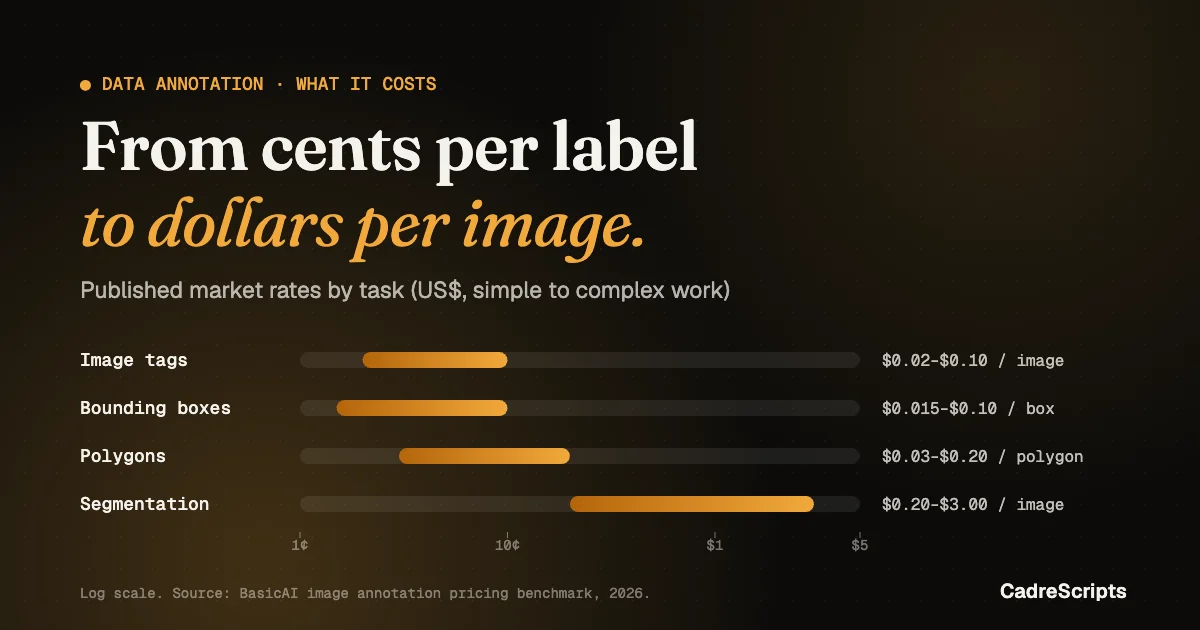
Simple data annotation costs cents per label: published rates for image tags run about $0.02–$0.10 per image and simple bounding boxes about $0.015–$0.10 per box. Detailed work like segmentation costs $0.20–$3.00 per image or more. The number that matters is the cost per accepted label after quality review, not the headline rate.
What does data annotation cost?
Published prices cluster by task. These are market ranges from one 2026 benchmark of image annotation vendors (BasicAI), so treat them as a direction, not a quote.
| Task | Typical published rate | What drives it up |
|---|---|---|
| Image classification (tags) | $0.02–$0.10 per image | More classes, attributes and judgments per image |
| Bounding boxes | $0.015–$0.10 per box for simple tasks; up to $1.00 across the wider market | Many small or overlapping objects, tight precision rules |
| Polygons | $0.03–$0.20 per polygon | Irregular outlines, more points per shape |
| Segmentation | $0.20–$3.00 per image (often) | Pixel-level masks, many classes per image |
| Managed team, hourly | $3–$12 per hour for general teams; up to about $60 for specialists | Domain expertise (medical, legal), language, review depth |
Audio and text work is priced the same way: per item (a clip, a transcript segment, a document) or per hour, with specialist skills as the multiplier.
The three ways vendors charge
Per label. You pay for each box, polygon or tag. It’s the clearest model when the number of objects changes from image to image, and it makes vendors easy to compare.
Per item. One price per image, clip or page, however many labels it holds. Easier to budget when every item looks roughly the same.
Per hour. Best when the work is unpredictable: dense scenes, new edge cases, or guidelines still changing. You need to know how many accepted labels an hour buys.
Turn every quote into the same unit before comparing. At $6 an hour, an annotator who gets 300 boxes an hour accepted costs $0.02 a box; one who gets 60 accepted costs $0.10 (BasicAI’s worked example). Same hourly rate, five times the price.
Why the cheapest quote often costs more
A label that fails review has to be redone, by someone. If a vendor’s price excludes review, or their accepted rate is low, you pay twice: once for the bad label and again to fix it. Worse, errors that slip through end up in your training data, where they’re much harder to find.
So ask every vendor the same three questions:
- Is quality review included in the price, and how much of the work is reviewed?
- What happens to labels that fail review, and who pays for the rework?
- Can we start with a small paid pilot before committing to volume?
How annotation quality is checked
Good vendors use more than one check, because each one catches a different problem.
A gold standard set. A small set of examples labeled and verified by experts, built before large-scale work begins. Without it, quality numbers only tell you whether annotators agree with each other, not whether they’re right (Encord).
Inter-annotator agreement. Two or more people label the same items and the overlap is measured. Agreement shows consistency, not correctness: annotators can agree and still be wrong if the guidelines are unclear. Chance-corrected scores such as Cohen’s kappa (two annotators) or Fleiss’ kappa (three or more) are more honest than simple percent agreement, and spatial labels like boxes are compared with IoU, the overlap between two shapes.
Review by sampling. For simple, low-stakes tasks a spot check of about 5–10% of the output is common; high-stakes work such as medical images gets full or near-full review (Encord).
Adjudication. When annotators disagree, a senior reviewer decides, and recurring disagreements go back into the guidelines so the same question doesn’t come up twice.
A report that says “98% accuracy” means little on its own. Ask: accurate against what (a gold set?), measured how, and on how many items?
How to keep annotation costs down
- Write the guidelines first. Most rework comes from vague rules. Show examples of edge cases and what to do with them.
- Run a pilot. Label a few hundred items, check them against your gold set, fix the guidelines, then scale.
- Match precision to the model. Don’t pay for pixel-perfect masks if boxes will do the job.
- Ask for your format up front. Getting COCO JSON, YOLO text or your own schema at delivery saves conversion work later.
How CadreScripts prices annotation
Our data annotation service covers bounding boxes, polygons and segmentation, image tagging, audio labeling, speech data for speech recognition and text annotation. Projects are quoted per project after we see your data and guidelines, with a $100 minimum. Every project starts with a pilot batch you can check before production, reviewers check work for consistency throughout, and we deliver in your format. Speech data is our core strength: verbatim, time-aligned transcripts come from the same team behind our human transcription.
Tell us about your project and we’ll quote it, or start with a pilot batch.
FAQ
How much does it cost to label 10,000 images?
It depends on the task. As a rough guide from published rates, simple tags at $0.02–$0.10 per image come to $200–$1,000; bounding boxes depend on how many objects each image holds. Ask for a quote per accepted label, with review included.
Is per-hour or per-label pricing better?
Per label is easier to compare and budget when the task is stable. Per hour suits complex or changing work. Either way, convert to cost per accepted label before deciding.
What is inter-annotator agreement?
A measure of how consistently different annotators label the same items. High agreement means clear guidelines; it doesn’t prove the labels are correct, which is what a gold standard set checks.
Why should I pay for a pilot?
A pilot shows you real quality and real throughput on your own data before you commit, and it surfaces unclear guidelines while they’re cheap to fix.
Sources, checked 12 November 2026: BasicAI, How much do image annotation services cost? The global benchmark; Encord, Data labeling quality control: consensus, inter-annotator agreement and QA workflows (6 July 2026).