
Transcription
Verbatim Transcription Notation: How to Mark Inaudible Words, Crosstalk and Pauses
How verbatim transcripts mark inaudible words, crosstalk, pauses and other sounds, with a table of common tags and tips for applying them consistently.
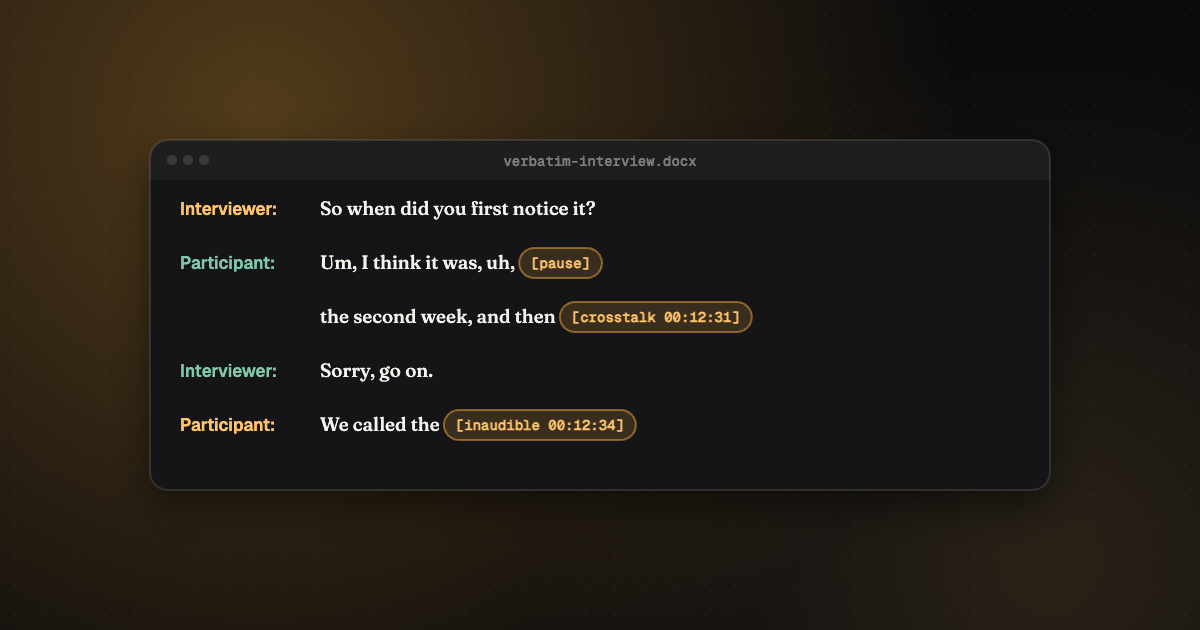
Somewhere in your recording, two people talk at once, a lorry goes past, and someone says a word nobody can make out. In a clean, readable transcript you’d smooth over it. In a verbatim transcript, you have to show it, consistently, so a researcher, lawyer or reviewer knows exactly what was and wasn’t heard. Here’s how verbatim transcription notation works.
Verbatim transcripts mark what can’t be transcribed normally with tags in square brackets, usually with a timestamp: [inaudible 00:12:34], [crosstalk 00:12:31], [pause], [laughs]. Fillers like “um” and false starts stay in. The exact tags matter less than using the same ones every time and agreeing them before work starts.
Common verbatim transcription tags
| Tag | Use it when | Example |
|---|---|---|
| [inaudible 00:12:34] | A word or phrase can’t be made out | We called the [inaudible 00:12:34] office. |
| [unclear: word? 00:12:34] | You have a best guess but aren’t sure | She works at [unclear: Halden? 00:04:10]. |
| [crosstalk 00:12:31] | People speak over each other | And then we — [crosstalk 00:12:31] |
| [pause] or (3 sec) | A noticeable silence matters | I don’t know. [pause] Maybe. |
| [laughs], [sighs], [coughs] | A non-speech sound carries meaning | That was the plan. [laughs] |
| [background noise] | Noise covers speech | [background noise 00:20:05] |
| — (dash) | A sentence is cut off or restarted | We went to the — we drove there. |
| [foreign language] | Speech in another language isn’t being transcribed | [speaks Spanish 00:08:40] |
Different organizations use different conventions: some prefer round brackets, some put timestamps only on inaudible sections, some add [redacted] for names removed for privacy. Pick a style guide and stick to it.
What verbatim keeps that other styles remove
- Fillers: um, uh, er, like (when used as filler), you know.
- Repetitions and stutters: “we, we, we went”.
- False starts: “I was going to — actually, no.”
- Grammar as spoken: nothing is corrected.
For a side-by-side comparison of verbatim, clean verbatim and intelligent verbatim, and help choosing one, start with our guide on how to transcribe audio to text.
Who needs verbatim notation
- Qualitative researchers, especially for conversation and discourse analysis, where pauses and overlaps are data.
- Legal and HR teams, where a transcript may be relied on as a record.
- Journalists checking a contested quote.
- Market researchers analysing hesitation and emphasis in focus groups.
Always timestamp inaudible and unclear sections. It lets anyone go straight back to the audio to check, and it shows the gap was marked honestly rather than guessed.
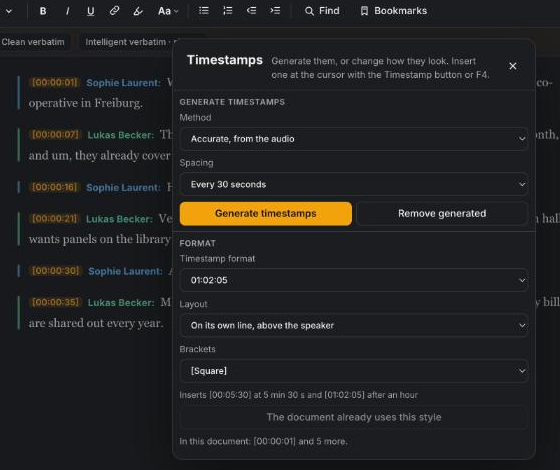
Adding tags quickly
Typing “[inaudible 00:12:34]” by hand, with the right time, gets old quickly. In the free CadreScripts editor, press F9 in the transcript for a menu of tags such as [inaudible] and [crosstalk] with the playhead time already filled in, then press 1–9 to pick one. You can edit the list to match your own style guide, and it’s saved with your settings. F4 inserts a plain timestamp at the cursor.
Checking a verbatim transcript
- Listen to every tagged section again. Some “inaudible” words become clear on a second listen at slower speed.
- Check tag consistency: search for each tag and make sure the format matches.
- Check speakers around crosstalk, where labels most often go wrong.
- Don’t let tidying creep in. Spell-check and auto-correct can quietly “fix” verbatim speech.
Verbatim is slow, careful work. Our human verbatim transcription costs from $1.10 a minute with a 24-hour turnaround on files up to an hour (pricing).
Frequently asked questions
How do you mark inaudible speech in a transcript?
Use a tag in square brackets with a timestamp, such as [inaudible 00:12:34], so the reader can find that point in the audio.
What does [crosstalk] mean in a transcript?
That two or more people spoke at the same time and the overlapping speech couldn’t be fully transcribed.
Should verbatim transcripts include “um” and “uh”?
Yes. Keeping fillers is what makes a transcript verbatim. Clean verbatim removes them.
Your next step
Add tags and timestamps in seconds: try the editor free in your browser. Or get verbatim transcription done to your style guide.
Keep reading