
Transcription
The Rise of the AI Transcript Editor: Why Human Review Still Matters
AI transcription is fast but still makes confident mistakes. What an AI transcript editor does, when AI alone is enough, and when human review is essential.
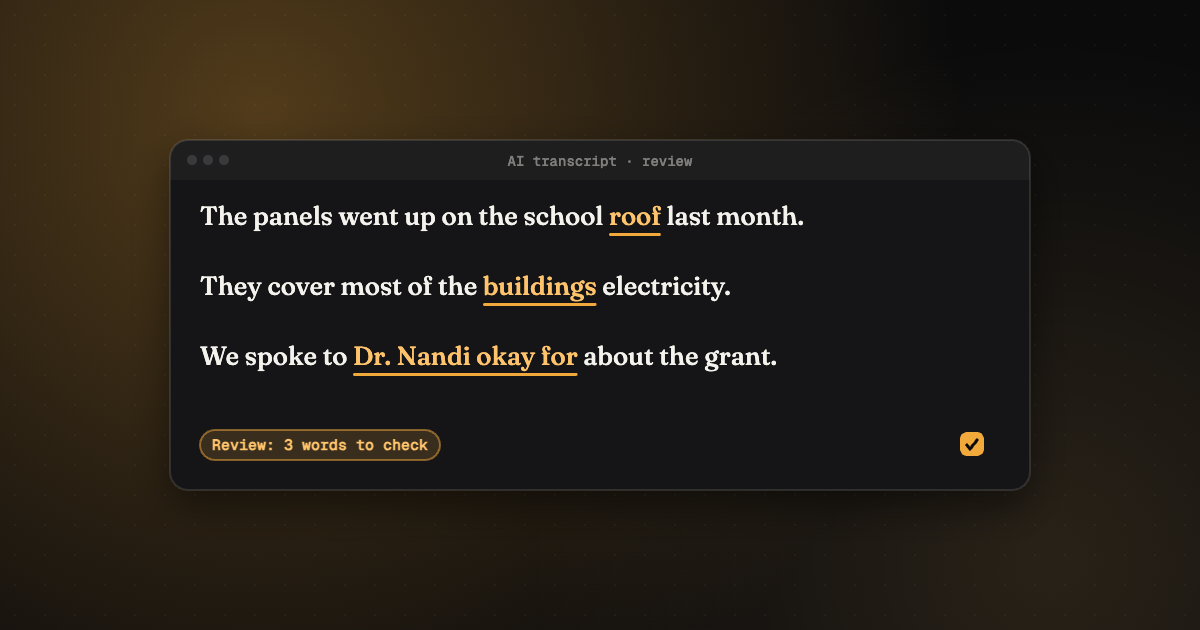
A few years ago, the headlines said speech recognition would put transcriptionists out of work. Instead, something more interesting happened. As organizations ran AI transcription at scale, they found that speed doesn’t guarantee accuracy, and a new role appeared in the middle: the AI transcript editor.
AI transcription is fast and cheap but still makes confident mistakes with names, numbers, accents and overlapping speakers. An AI transcript editor checks the machine’s draft against the audio and fixes what it got wrong. For transcripts that will be published, quoted or relied on, that human review is still essential.
Why AI transcription changed the industry
Modern speech recognition turns an hour of audio into a draft in minutes. For clear, single-speaker recordings on good microphones, the result can be very good. That changed the economics: typing from scratch is now rarely the best use of a skilled transcriptionist’s time.
But accuracy depends heavily on the recording. Brass Transcripts’ 2026 industry roundup cites research finding the average AI platform reaching about 62% accuracy on typical business audio with background noise, several speakers and varied accents, against roughly 99% for human transcription (figures from Sonix, as compiled in Brass Transcripts’ 2026 roundup). Real recordings are rarely as clean as demos.
Why AI transcription still makes mistakes
| Cause | What goes wrong |
|---|---|
| Technical terms and names | Swapped for common words that sound similar |
| Overlapping speakers | Words lost, turns given to the wrong person |
| Background noise and echo | Missing or invented words |
| Accents and mixed languages | Wrong language forced onto speech |
| Missing context | Grammatical sentences that mean something different |
At CadreScripts, we’ve seen this firsthand
Since adopting AI-assisted workflows, we’ve reviewed thousands of machine-generated transcripts across business meetings, podcast interviews, research projects, webinars, customer interviews and legal recordings.
Most AI errors aren’t dramatic. They’re subtle. A missing word. A wrongly identified speaker. An incorrect product name. A medical abbreviation expanded the wrong way. A sentence that technically makes sense but completely changes the intended meaning. These are exactly the mistakes software struggles to detect, because they need human reasoning rather than statistical prediction. That’s why transcript editing remains an essential quality step.
What an AI transcript editor actually does
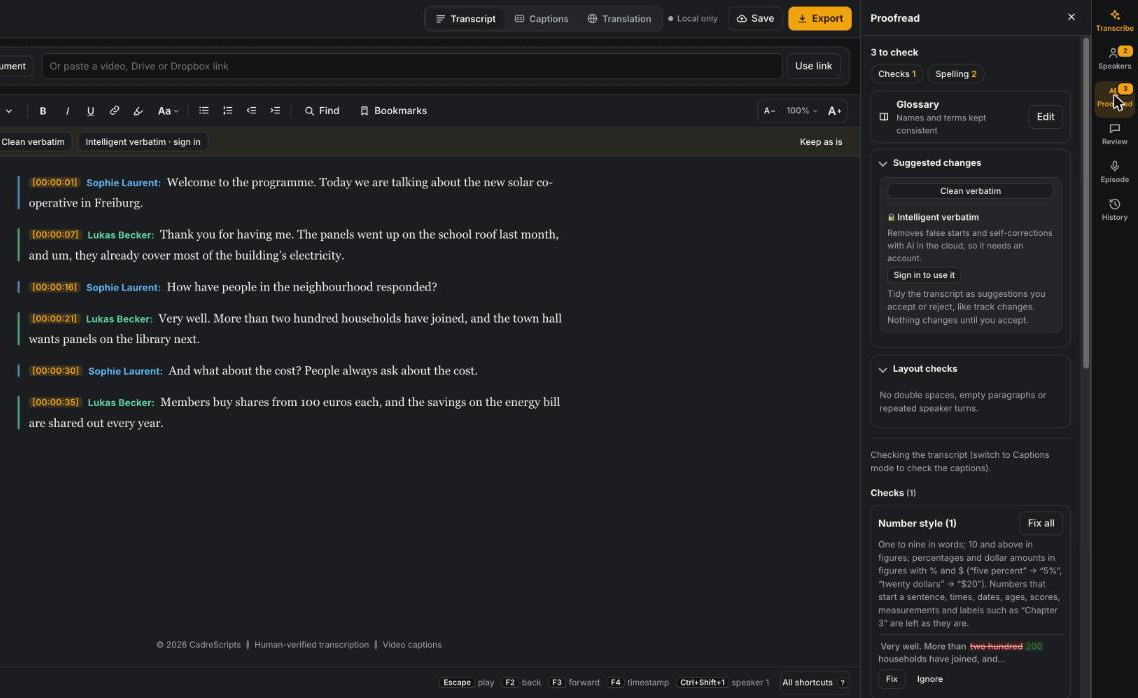
- Checks flagged words first. AI marks where it was unsure; that’s where errors cluster.
- Fixes names, terms and numbers against the audio and a glossary.
- Corrects speakers, especially around interruptions.
- Applies the right style: verbatim, clean verbatim or edited.
- Formats and exports: timestamps, Word, PDF or captions.
When AI transcription is enough, and when it isn’t
| AI alone is usually fine for | Human editing is essential for |
|---|---|
| Internal meeting notes | Legal, HR and compliance records |
| Searching an archive | Research data analyzed word by word |
| Rough drafts you’ll check yourself | Published quotes and articles |
| Clear one- or two-speaker audio | Noisy, multi-speaker or mixed-language audio |
Human-in-the-loop: the best of both
The model that works for most teams has two phases. First, AI generates the draft in minutes. Second, a person verifies it against the audio, focusing on flagged words, speakers, names and numbers. You get most of the speed and cost savings of AI with accuracy you can stand behind.
Check an AI transcript yourself in the free CadreScripts editor: click any word to hear it, fix speakers in one place, and run proofreading checks. Signed-in users can also order a human-verified version from inside a project, with every corrected word marked by Show changes.
How CadreScripts combines the two
Our team works exactly this way: AI for the first pass, experienced editors for the check. Human-verified transcription starts from $0.80 a minute for edited and $1.10 for verbatim, with a 24-hour turnaround on files up to an hour (pricing). To compare every method, read how to transcribe audio to text, or decide per job with human or AI transcription: a project-by-project guide.
The future of transcript editing
AI drafts will keep improving, and the editor’s job will keep shifting from typing to judgement: knowing which errors matter, what the speaker meant, and when a transcript is ready to be relied on. That judgement is the part that doesn’t automate well.
Frequently asked questions
What is an AI transcript editor?
A person, or a tool used by a person, who reviews an AI-generated transcript against the audio and corrects its errors, speakers and formatting.
Is AI transcription accurate enough on its own?
For clear audio and internal use, often yes. For noisy recordings, many speakers, or anything published or relied on, it needs human review.
How long does editing an AI transcript take?
From about a quarter of the audio length for clear recordings to as long as the recording itself for difficult audio.
Your next step
Review an AI draft the fast way in the free editor, or get human-verified transcription.
Keep reading