
Transcription
The Future of Transcription: Trends to Watch and Tips for Accurate Transcripts
Five transcription trends to watch, from AI drafts with human checking to mixed-language recordings and caption laws, plus tips for accurate transcripts.
Ten years ago, transcription meant a pair of headphones, a foot pedal and a long afternoon. Today a machine drafts an hour of audio in minutes. So what’s left to change? Quite a lot, as it turns out, and most of it is about what happens after the first draft. Here are the transcription trends worth watching, and what they mean for getting accurate transcripts.
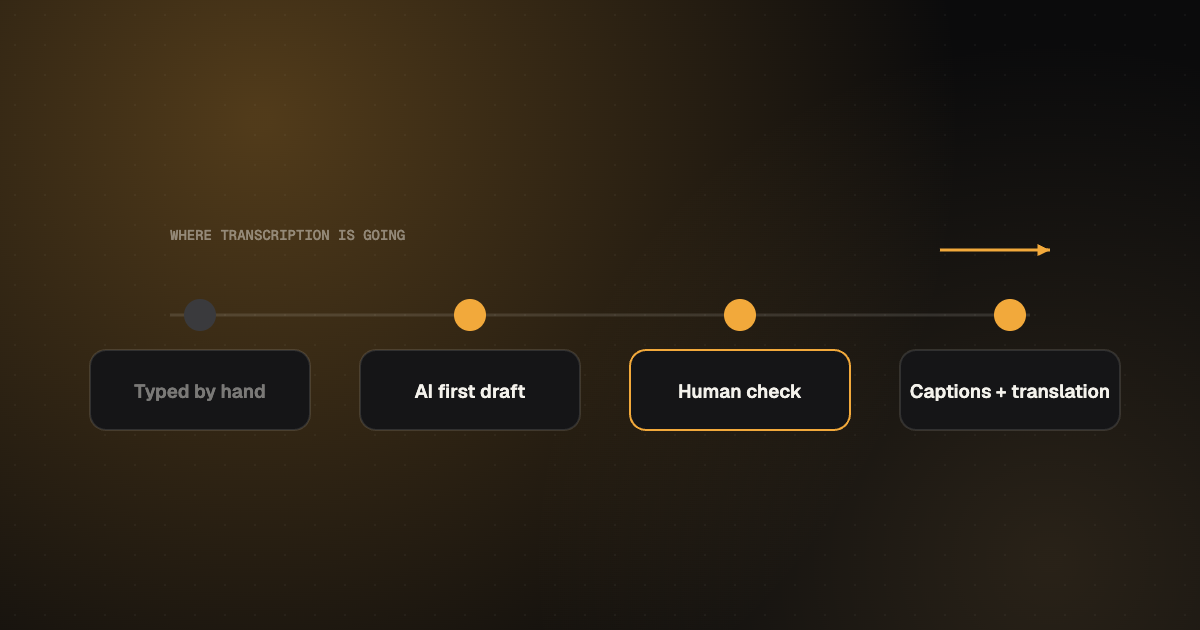
Transcription is moving from typing to checking: AI writes the first draft, and people review, correct and approve it. The other big shifts are recordings that mix languages, captions required by accessibility law, transcripts as the raw material for summaries and translation, and more attention to where recordings are stored.
Trend 1: from typing to checking
The job of a transcriptionist has changed. Less typing from scratch, more listening to an AI draft and fixing what it got wrong: names, numbers, speakers and the words it guessed. That makes the editor as important as the engine. Click-to-play, flagged words and good keyboard shortcuts decide how fast a transcript gets from “mostly right” to “right”.
Trend 2: recordings that mix languages
More recordings switch languages mid-conversation: Spanish and English in the US, Hindi and English in India, English in almost every European meeting. Tools that let you set two languages before transcribing, so each part is written in the language spoken, are becoming essential rather than a nice extra.
Trend 3: captions required by law
Captions are moving from courtesy to obligation. In the US, the Department of Justice’s ADA Title II rule gives public bodies deadlines to make web content, including video, accessible: larger bodies from April 2026 and smaller ones from April 2027. The free caption compliance checklist sets out the requirements. It’s guidance, not legal advice.
Trend 4: the transcript as raw material
Summaries, show notes, chapters, translations, articles and AI search all start from a transcript. That raises the stakes: an error in the transcript becomes an error in everything built on it. Checking the transcript first is cheaper than fixing five downstream documents later.
Trend 5: privacy by default
Organizations are asking harder questions about where recordings go. Expect more tools that keep recordings on your own computer unless you choose to upload them, clearer retention periods, and more care with sensitive interviews.
Tips for accurate transcripts, whatever the tool
| Do this | Because |
|---|---|
| Record close to the mouth, one mic per person if you can | Audio quality matters more than any software |
| Add names and terms to a glossary before transcribing | Names are where AI fails most |
| Set the language, and a second one if speakers switch | Auto-detect picks one and forces it |
| Review flagged words first, then speakers | That’s where errors cluster |
| Check numbers against the audio | “Fifteen” and “fifty” sound alike |
For the full step-by-step, see our guide on how to transcribe audio to text. To check AI transcripts quickly, use the free CadreScripts editor; when it must be right, our human transcription starts from $0.80 a minute (pricing).
Frequently asked questions
Is transcription still a growing field?
Yes. The amount of recorded speech keeps rising, and so does the need for accurate, checked transcripts and captions, even as AI does more of the first draft.
What will transcriptionists do in future?
More reviewing and correcting of AI drafts, specialist work such as legal, medical and multilingual transcription, and quality checking for captions and translation.
Your next step
Try reviewing an AI draft the fast way: open the editor free in your browser. Or get human-verified transcription.
Keep reading