
Transcription
Human or AI Transcription? A Project-by-Project Guide
Which transcription to use for each kind of project: meetings, sales calls, podcasts, journalism, research, focus groups, legal and HR.
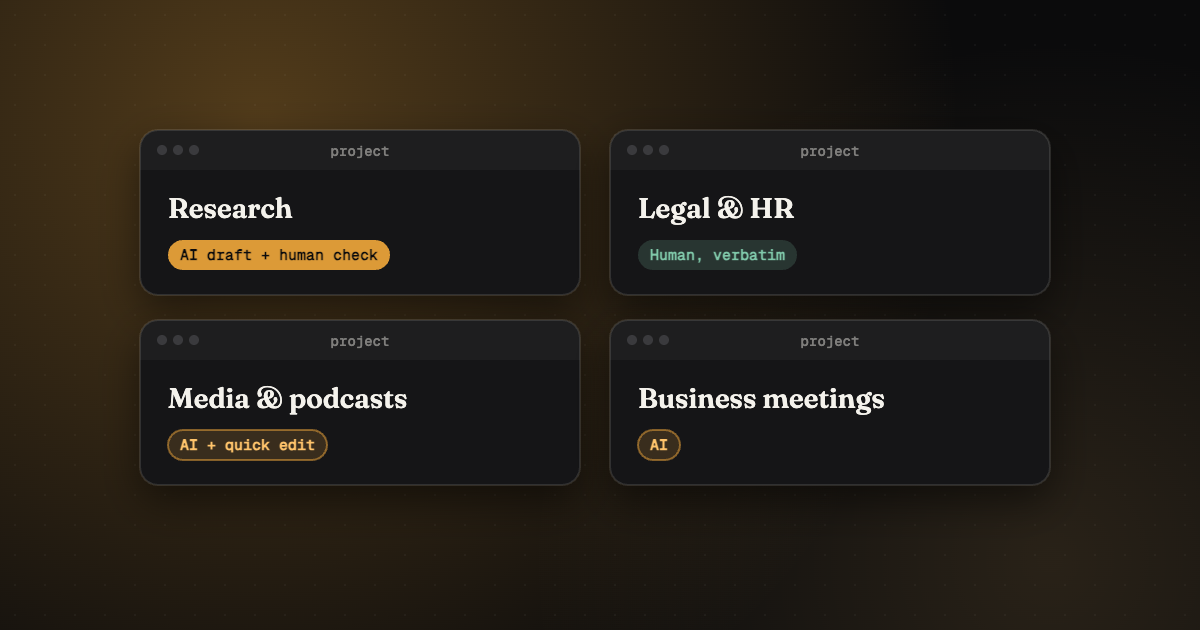
“Should we use AI or a person?” is the wrong question to ask in general and the right one to ask per project. A weekly team meeting and a disciplinary hearing are both “recordings”, but a mistake costs very different amounts in each. Here’s a project-by-project guide to human or AI transcription, so you can decide in a minute instead of a meeting.
Use AI for internal, low-stakes recordings with clear audio. Use AI plus a human check for research, journalism and anything you’ll quote. Use human transcription, usually verbatim, for legal, HR and compliance work, and for noisy or multi-speaker audio. The deciding question is what one wrong word would cost.
The one question that decides it
Ask: if a name, number or sentence in this transcript is wrong, what happens? If the answer is “nothing much”, AI is fine. If it’s “we’d look careless”, add a human check. If it’s “someone could be harmed, sued or misquoted”, pay for a person.
Project by project
| Project | Our pick | Why |
|---|---|---|
| Team meetings, stand-ups | AI | Skimmed once, filed; small errors don’t matter |
| Sales and customer calls | AI, check numbers | Prices and dates are where errors hurt |
| Podcast episodes | AI plus a quick edit | Published, so names and spellings must be right |
| Journalism interviews | AI plus a careful check; human for contested quotes | Quotes are attributed to real people |
| Academic research (thematic) | AI draft plus a human check | Accuracy matters; budgets are tight |
| Research (conversation analysis) | Human verbatim | Pauses and overlaps are data |
| Focus groups | Human | Many speakers and crosstalk defeat AI labeling |
| Legal, HR, investigations | Human verbatim | The transcript may be relied on as a record |
| Medical or technical | Human or a specialist check | Terminology errors are common and serious |
| Recordings that mix languages | AI with both languages set, then a bilingual check | Switch points are where AI fails |
Audio quality changes the answer
The table assumes reasonable audio. Move one step toward human when the recording has background noise, echo, phone audio, strong accents, or more than three speakers. Move one step toward AI when it’s a clean, two-person recording on good microphones.
Unsure? Run AI on a 10-minute sample and count the errors you’d have to fix. If fixing takes longer than a third of the audio length, a human transcript is probably better value.
The hybrid that suits most teams
For most professional work, the best value is an AI draft that a person checks against the audio. You can do the check yourself in the free CadreScripts editor, with click-to-play, speaker tools and proofreading checks, or signed-in users can order a human-verified version from inside a project. For costs, accuracy and the full trade-offs, see our guide on how to transcribe audio to text.
Our prices for reference (pricing, checked 6 November 2026): AI transcription from $0.15 a minute, human edited from $0.80, human verbatim from $1.10.
Frequently asked questions
Is AI transcription good enough for research?
As a first draft, often yes, if a person checks it against the audio. For methods that analyze pauses and overlaps, use human verbatim transcription.
Should legal recordings be transcribed by AI?
Not on their own. Legal and HR transcripts should be done or fully checked by a human, usually in verbatim style.
What about focus groups?
Use human transcription. Many speakers and frequent crosstalk make AI speaker labels unreliable.
Your next step
For projects where every word counts, get human transcription. For the rest, check your AI draft in the free editor in your browser.
Keep reading