Human vs AI Transcription: Cost, Accuracy and When to Pay for a Human
Human vs AI transcription compared on cost, speed and accuracy, with clear advice on when AI is enough and when to pay for a person.
In this article
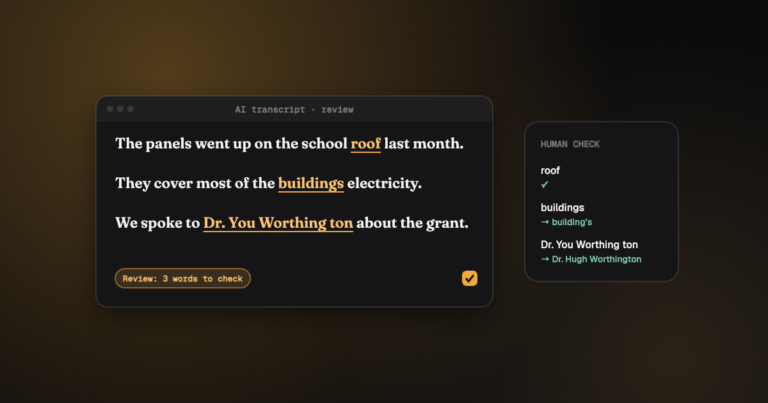
The AI transcript came back in two minutes. It looked great. Then you got to the part where your guest, Dr. Hugh Worthington, became “Dr. You Worthing ton”, and the quarterly figure of fifteen million turned into fifty. Human vs AI transcription isn’t really a contest of speed. It’s a question of what a mistake would cost you.
AI transcription is far cheaper and faster, and good enough for clear audio you’ll use internally. Human transcription costs more and takes hours, but it handles difficult audio, names, accents and strict styles, and it’s what you need when the transcript will be published, quoted or used as evidence. Many teams use both: AI first, then human checking.
Human vs AI transcription at a glance
| AI transcription | Human transcription | |
|---|---|---|
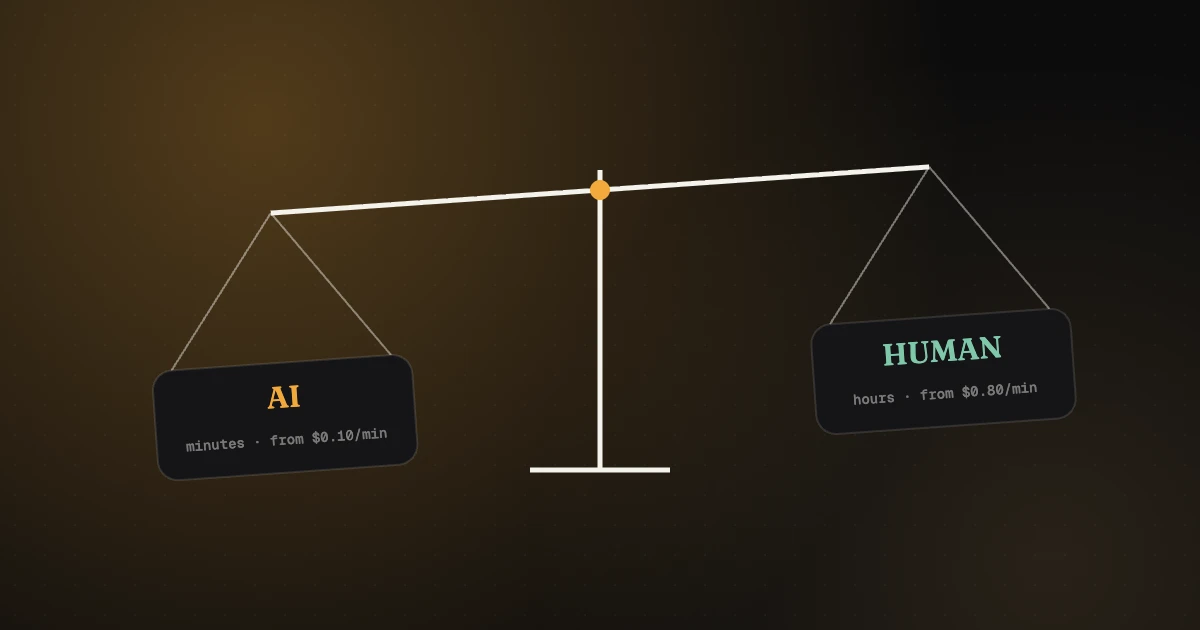
| Speed | Minutes (about two minutes per hour of audio in our editor) | Hours to a day (ours: 18 hours for a 60-minute file) |
| Cost | From $0.10 a minute pay as you go at CadreScripts | From $0.80 a minute (edited) or $1.10 (verbatim) |
| Clear audio, one or two speakers | Often very good | Very good |
| Noise, crosstalk, accents | Drops quickly | Holds up far better |
| Names, jargon, numbers | Common errors | Researched and checked |
| Strict verbatim (legal, research) | Inconsistent | Follows the style you specify |
| Who checks it | You | The transcriptionist |
Prices from our pricing page, checked 6 November 2026.
Where AI transcription is genuinely good
We’re a company that sells human transcription, so you might expect us to be sniffy about AI. We’re not. For a lot of work, AI is the right tool.
- Meeting notes you’ll skim once and file.
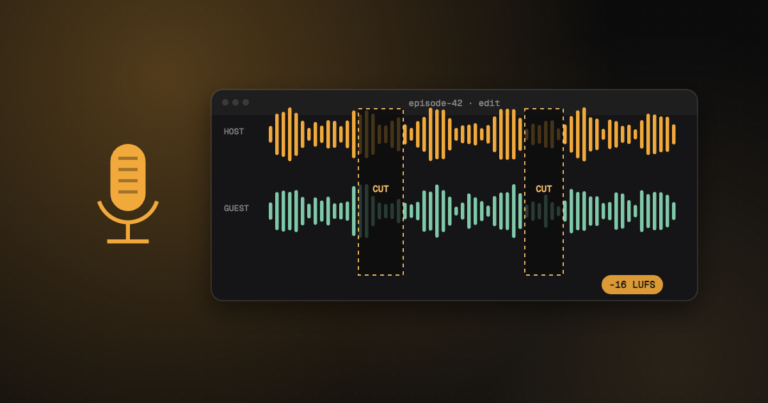
- Planning a podcast edit, where you only need to find things (see our guide to editing a podcast).
- First drafts of interviews you’ll check yourself.
- Searching a large archive where “mostly right” is enough to find the bit you need.
- Clear recordings: a good microphone, one or two speakers, standard vocabulary.
In those cases, paying a person to type it is hard to justify. Get the AI draft and spend your money elsewhere.
Where AI transcription still struggles
AI errors aren’t random. They cluster in the same places, and they’re usually the places that matter most.
Names and specialist words
Speech recognition guesses the most likely word. Your guest’s surname, your product, a drug name or a legal term is rarely the most likely word. It gets swapped for something common that sounds similar, and because the result is a real word, spell-check won’t catch it.
Numbers
“Fifteen” and “fifty”. “Thirteen” and “thirty”. In a sales call or a financial interview, one wrong digit changes the meaning entirely.
Difficult audio
Background noise, echo, phone lines, people talking over each other and strong accents all lower accuracy, often sharply. The cleaner-than-real-life recordings used in AI demos aren’t what most people actually record.
Who said what
Speaker identification (diarization) often merges two similar voices, splits one voice into two, or gives a short interjection to the wrong person. In a focus group or a legal interview, that’s not a small error.
Confident mistakes
The real problem: AI doesn’t say “I didn’t catch that.” A human transcriptionist marks a word as [inaudible] or flags a guess. AI writes something plausible and moves on, so errors look exactly like correct text.
Any accuracy percentage you see is for a particular kind of audio. A tool that’s excellent on a studio podcast can struggle on a noisy phone interview. Test it on your own recordings before trusting a number.
The middle option: AI plus human checking
For most professional work, the best value isn’t pure AI or pure human. It’s an AI draft, then a person checking it against the audio. The machine does the typing; the person does the listening and the judgement.
You can do the checking yourself. A good editor makes it fast by underlining the words the AI was unsure about and letting you step through and play each one. In CadreScripts Desk, the Review bar does exactly that, and Proofread catches numbers, spelling and layout slips.
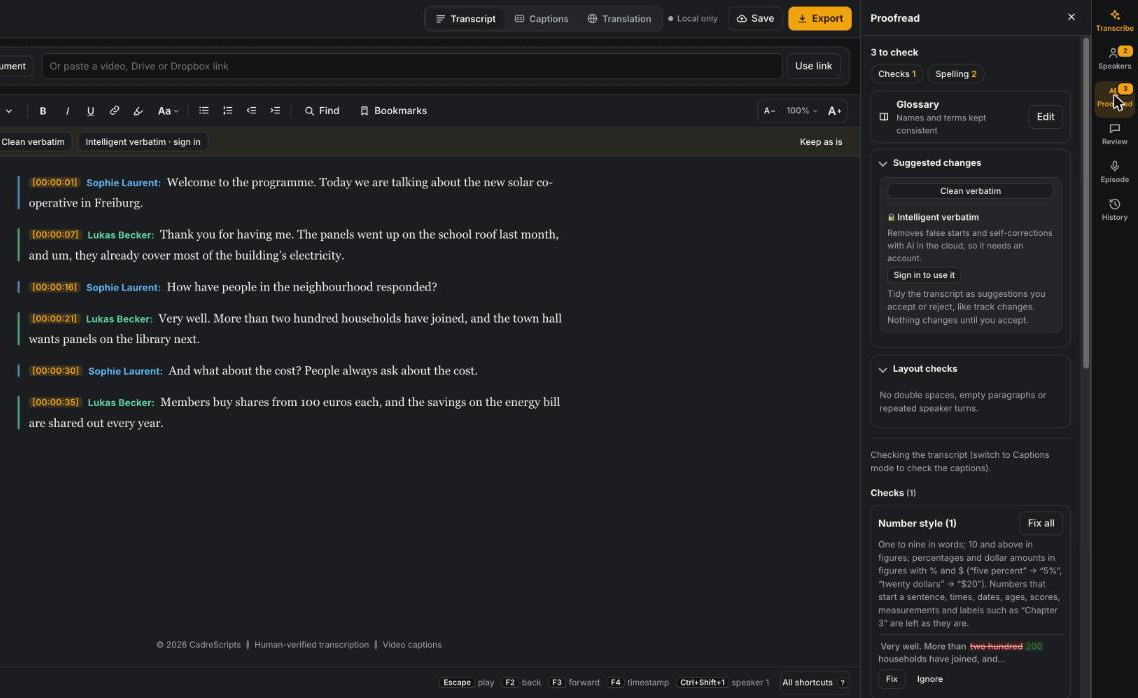
Or you can hand the checking to us. From inside a project, signed-in users can order a human-verified version: our team checks the transcript against the recording and it comes back as its own project, with Show changes marking every word that was corrected. That’s also a useful way to see where AI went wrong on your kind of audio.
Cost: what the difference really is
Take ten hours of interviews a month (600 minutes):
| Approach | Monthly cost | Your time |
|---|---|---|
| AI only, pay as you go ($0.10/min) | $72 (the minimum order; $60 at the rate) | Checking it all yourself: several hours |
| AI on the Creator plan | From $24 a month, or $180 for 12 months (about $15 a month); 10 hours of audio a month covers all 600 minutes (unused hours roll over for one month) | Checking it yourself |
| Human, edited ($0.80/min) | About $480, less 5% at 10+ hours a month | Almost none |
| Human, verbatim ($1.10/min) | About $660, less 5% at 10+ hours a month | Almost none |
The question isn’t which line is cheaper (AI, obviously). It’s whether your hours of checking are worth more than the difference. For a researcher on a grant, maybe not. For a consultant billing by the hour, almost certainly.
Want to run your own numbers? The free transcription cost calculator compares AI, human checking and captions for your hours of audio.
When to pay for a human
Pay for human transcription when any of these is true:
- The transcript will be published or quoted under your name.
- It may be used as evidence, or in a legal, HR or compliance process.
- It’s research data you’ll analyze word by word.
- The audio is noisy, has many speakers, or mixes languages.
- You need a specific style, such as strict verbatim, consistently.
- Your own time costs more than the difference in price.
If none of those apply, start with AI and see how much fixing it needs.
Our recommendation by use
| Use | AI | AI + human check | Human |
|---|---|---|---|
| Internal meeting notes | Yes | ||
| Podcast show notes and search | Yes | For a published transcript | |
| Journalism interviews | Yes | For contested quotes | |
| Academic research | Yes | For verbatim analysis | |
| Market research focus groups | Yes | ||
| Legal and HR | Yes | ||
| Captions for public bodies | Yes | Yes |
For teams: try both on your own audio
The fairest test is your own recordings. If your team transcribes regularly (5 or more hours a month, or a one-time project of 9 hours or more), you can request a business plan and a free trial from our pricing page. Use a work email that matches your company website; it’s one trial per company, and we confirm each one.
Frequently asked questions
Is AI transcription as accurate as human transcription?
On clear audio with one or two speakers, AI can come close. On noisy recordings, many speakers, accents or specialist vocabulary, a trained human is still clearly more accurate, especially for names and numbers.
Is human transcription worth the cost?
When mistakes are expensive, yes: published quotes, legal or HR records, research data and difficult audio. For internal notes on clear recordings, AI usually gives better value.
How much faster is AI transcription?
Much faster. AI returns a draft in minutes; human transcription usually takes hours to a day. But remember to count the time you spend checking the AI draft.
Can I combine AI and human transcription?
Yes, and it’s often the best value: AI writes the first draft, and a person checks it against the audio. You can do the check yourself in an editor or order a human-verified version.
Will AI replace human transcriptionists?
It has changed the job more than replaced it. Much of the work is now checking and correcting AI output, which still needs people who listen carefully and know the subject.
Your next step
Have an AI transcript already? Try the editor free in your browser and see how quickly you can check it. When it has to be right, get human-verified transcription. For more on choosing a method, read our full guide on how to transcribe audio to text.